
Home Appliances · Buying Guide
Almost every vacuum cleaner sold in India leads with a wattage figure, and almost every buyer treats it as a measure of suction. It isn’t. Watts describe how much electricity the motor draws from the wall, not how much dirt the machine lifts off your floor.
That single misunderstanding is why so many people end up with a 1600W machine that struggles with basic dust while a 1200W one clears it in a pass. The numbers that actually matter are kilopascals, which measure sealed suction, and airflow in litres per second, which is what drags debris across a floor and into the hose. Almost nobody publishes the second one. One brand on this list does, and that tells you something.
Indian homes also need a different machine from the ones Western vacuum marketing is built around. We have hard floors rather than wall-to-wall carpet, far more airborne dust, and a household culture where spills get mopped immediately. Which is why wet-and-dry canisters — barely a category in Europe — dominate here.
Five machines below, covering three genuinely different types. Reviews first, then a buying guide that explains which type you actually need before you spend anything.
Disclosure: This page contains affiliate links. If you buy through them we may earn a small commission at no extra cost to you. It does not influence the rankings or soften the criticism. Scores are our editorial assessment based on published specifications, filtration, warranty terms, service reach and aggregated owner feedback.
The 5 best vacuum cleaners for Indian homes
SEZNIK Turbo Sweep 3-in-1 Vacuum Cleaner & Mop (SZ-V07)

This is the smallest and cheapest machine here, and it is solving a different problem from the other four. It is a corded handheld that vacuums and mops in the same pass — dry dust into a 600ml cup, water from a 200ml tank onto a microfibre pad dragged behind it.
For a one or two bedroom flat that is a genuinely sensible proposition. You are not hauling a canister between rooms, there is no bag to buy, and the daily reality of Indian floors is dust followed by a mop, which is exactly the sequence this machine collapses into one job. Over 20 kPa of suction is respectable for something this size, and the Turbo Sweep head handles tiles, hardwood and thin rugs.
Be clear-eyed about the limits. A 600W motor is not deep-cleaning a thick carpet or a heavily soiled sofa. The 200ml tank is roughly one room before a refill. And this is a mopping vacuum, not a wet vacuum — it will not suck up a spilled glass of water the way the AGARO or the Eureka Forbes Armor will.
Seznik is an Indian brand with a 12-month offsite warranty that includes free pick-up and drop from your door, plus a live video demo instead of a physical one. For a small brand, doorstep collection is a better deal than it first sounds.
Pros
- Vacuums and mops in a single pass
- Light, handheld, no canister to drag around
- HEPA filtration and a bagless 600ml cup
- Free doorstep pick-up and drop under warranty
Cons
- 600W is not enough for carpets or heavy upholstery
- 200ml tank needs frequent refilling
- Cannot vacuum liquid spills, only mop
- Small brand with a limited service footprint
Buy it ifYou live in a compact flat with tiled or wooden floors, and your daily routine is dust-then-mop. It saves a genuine chore every day.
Skip it ifYou have carpets, pets, or need to handle actual wet spills. This is a light-duty machine and it is honest about that.
AGARO Ace Wet & Dry Vacuum Cleaner, 1600W

If someone asks me for one recommendation without telling me anything about their home, this is the answer. The AGARO Ace does more different jobs than anything else on this list, and it does them for around six to seven thousand rupees.
Twenty-one litres of stainless steel tank is the headline. That is enough to vacuum an entire house, clean out a car, deal with a burst-pipe puddle and still not need emptying. The 21.5 kPa suction is strong for the money, and the blower function reverses airflow so you can chase dust out of window channels, door frames and computer cabinets — the places a nozzle physically cannot reach.
The design details are better than the price suggests. A washable 3-litre dust bag rather than disposables you keep rebuying. Four 360-degree swivel wheels, so it follows you instead of tipping over when you tug the hose. A five-metre cord. Seven accessories including a telescopic metal tube rather than the plastic ones that flex and crack.
Two honest caveats. Listings vary between 21 and 30 litres depending on the variant, so check which one you are ordering. And warranty is one year — shorter than the Philips, and worth weighing.
Pros
- Handles dry dust, wet spills and blowing in one machine
- 21 L stainless steel tank — clean a whole house in one go
- Washable dust bag, so no recurring bag cost
- Telescopic metal tube and 360° swivel wheels
Cons
- Bulky and heavy at over 7 kg
- Loud, as all wet-and-dry canisters are
- One-year warranty only
- Tank size varies by listing — verify before ordering
Buy it ifYou want one machine that covers everything — floors, sofas, the car, spills, and blowing dust out of corners. Best all-round value here.
Skip it ifStorage space is tight or you need something you can carry upstairs easily. This is a big appliance.
Philips PowerPro FC9352/01 Compact Bagless Vacuum Cleaner

This is the best-engineered machine on the list and the only one whose maker publishes numbers you can actually judge it by. Philips states 370W of suction power from a 1900W motor, a maximum vacuum of 33 kPa, and airflow of 37 litres per second.
That last figure is the one nobody else gives you, and it matters more than the others. Sealed suction tells you how hard the machine pulls against a blocked hose. Airflow tells you how much air actually moves across a floor and carries dust with it. High suction with poor airflow gives you a vacuum that grips a rug and picks up nothing. Philips publishing 37 l/s is a quiet admission of confidence.
PowerCyclone 5 spins air in a cylindrical chamber so dust separates out before it reaches the filter, which means suction stays consistent as the 1.5-litre container fills rather than tailing off. The sealed filtration system captures more than 99.9% of fine dust including pollen, pet hair and dust mites — genuinely relevant if anyone in the house has asthma or allergies, and the strongest reason to pick this over a cheaper machine.
Bagless, so no consumable cost. A turbo brush for hair, an integrated soft brush in the handle, 4.5kg, and a nine-metre working radius. Two years of warranty, double most rivals.
The complaint you will find repeatedly is noise. Philips publishes 82 dB, and owners on Philips’ own site describe it as very loud. That is a real drawback for a machine you may use in the evening.
Pros
- Only machine here publishing airflow — and it is strong
- Sealed filtration captures over 99.9% of fine dust
- Bagless with no consumable cost
- Two-year warranty and Philips’ service network
Cons
- Loud at 82 dB — a recurring owner complaint
- Dry only; will not touch a wet spill
- 1.5 L container needs emptying often
- Most expensive machine on this list
Buy it ifAnyone in the house has allergies or asthma, or you simply want the best dry vacuum here. The filtration and airflow justify the price.
Skip it ifYou need wet pick-up, or noise is a serious constraint in your home.
Eureka Forbes Quick Clean DX Vacuum Cleaner, 1200W
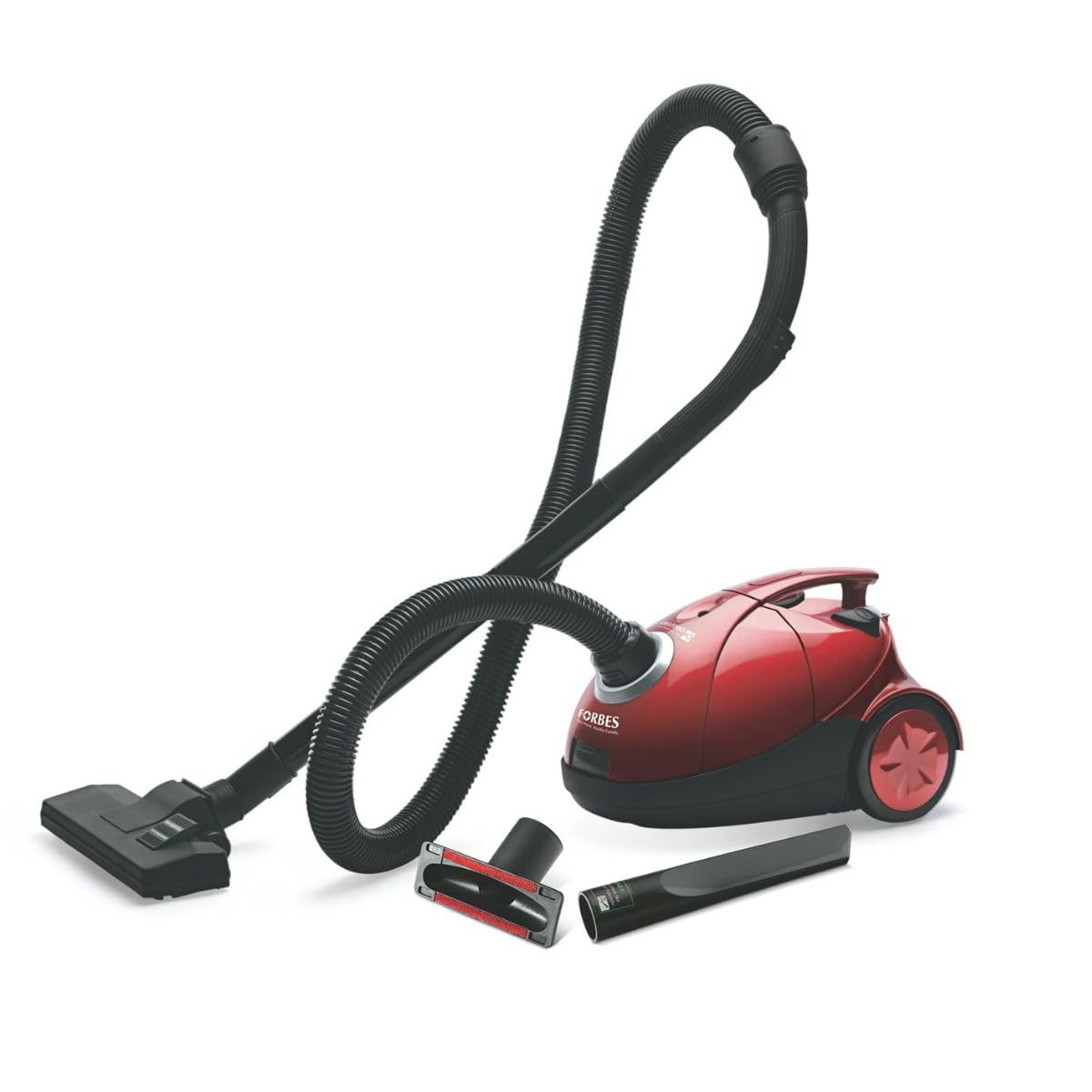
Eureka Forbes has been selling vacuum cleaners in India longer than most of its competitors have existed, and the Quick Clean DX is the model that shows what that experience buys you. It is not the most powerful thing here. It is the easiest to actually use.
Three details do most of that work. Suction control sits on the handle rather than the body, so you dial power down for curtains and up for the floor without bending to the canister. An automatic cord winder retracts the cable at a button press and stores it inside the unit — a small thing that removes the single most annoying part of vacuuming. And a dust bag full indicator tells you when to empty rather than leaving you to notice suction fading.
It ships with three reusable dust bags, so there is no ongoing consumable cost despite being a bagged machine, and a thermal cut-off shuts the motor down before it overheats. At 1200W and 2 litres it is aimed squarely at flats and small houses, and it is light enough to carry up a flight of stairs without resentment.
The important limitation, stated plainly in the manual: this is a dry vacuum only. Do not use it on wet surfaces or to pick up liquids. One Amazon reviewer’s advice is worth repeating — it is well suited to short regular sessions, and if you want something for long heavy cleaning, spend more.
Pros
- Suction control on the handle, not the canister
- Automatic cord winder with internal storage
- Three reusable bags included — no recurring cost
- Light, compact, and easy to carry between floors
Cons
- Dry use only — explicitly not for liquids
- 2 L capacity fills quickly in a dusty home
- Least powerful canister here at 1200W
- Better suited to short sessions than deep cleaning
Buy it ifYou want something you will actually pick up twice a week rather than dread. Ideal for flats and for anyone who wants simple.
Skip it ifYou need wet pick-up, deep carpet cleaning, or a tank you empty less often.
Eureka Forbes Wet & Dry Armor Vacuum Cleaner, 22 kPa

The Armor competes directly with the AGARO Ace, and the case for it comes down to one specification most brands do not bother quoting: the tank is 0.5mm thick stainless steel, which Eureka Forbes claims is the strongest in its segment.
That sounds like trivia until you have owned a wet-and-dry vacuum for a few years. The tank is the part that gets dragged across floors, knocked into door frames, filled with water and left to dry. Thin steel dents and eventually corrodes at the seams. Thicker steel does not. On a machine you intend to keep for a decade, wall thickness is a more honest durability signal than any wattage figure.
The rest is well judged. Twenty-two kilopascals of suction, marginally above the AGARO. A 20 litre tank. Blower function for window channels and hard-to-reach dust. Seven accessories covering floors, upholstery and crevices. Auto shut-off that cuts power when overheating is detected, which is the failure mode that kills cheap canisters.
Warranty is one year comprehensive, explicitly excluding consumables like filters and dust bags — standard for the category, but worth reading before you assume the filter is covered. Eureka Forbes also provides a post-purchase video demo with a dedicated executive, which is more useful than it sounds for a machine with seven attachments.
Pros
- 0.5mm stainless tank — built to outlast the category
- 22 kPa, the highest sealed suction among the canisters here
- Auto shut-off protects against overheating
- India’s most established vacuum service network
Cons
- Wattage not clearly published
- Warranty excludes filters and dust bags
- Heavy and loud in use
- Usually costs more than the comparable AGARO
Buy it ifYou want a wet-and-dry machine that will still be working in ten years, and you value Eureka Forbes’ service reach.
Skip it ifYou want maximum tank capacity per rupee — the AGARO gives you a litre more for less money.
How to choose a vacuum cleaner for an Indian home
Pick the type first. Everything else — power, capacity, filtration — only makes sense once you know which of these three you are buying.
The three types, and who each one suits
Handheld vacuum-mops like the SEZNIK are light, corded units that dust and mop in one pass. Best for small flats with hard floors and daily light cleaning. They will not deep-clean carpets or pick up standing water.
Dry canisters like the Philips and the Quick Clean DX are the classic pull-along vacuum. Better filtration, lighter, quieter than wet-and-dry, and the right choice if your cleaning is dust, hair and upholstery. They must never be used on liquids — water in a dry motor is how they die.
Wet-and-dry canisters like the AGARO Ace and the Armor are the workhorses. Large steel tanks, blower functions, and the ability to suck up a spilled bucket. Bulky, loud, and heavier — but one machine that handles the house, the car, the balcony and the occasional plumbing disaster.
Ignore wattage. Look at kPa and airflow.
Wattage is input power — how much electricity the motor consumes. It tells you about your bill, not your floors. A well-designed 1200W machine will beat a badly designed 1600W one.
Kilopascals (kPa) measure sealed suction: how hard the machine pulls when the hose is blocked. Above 20 kPa is good for home use; the machines here run 20 to 33.
Airflow, in litres per second, measures how much air moves through the machine, and it is what actually carries dust off a surface and up the tube. Strong suction with weak airflow gives you a vacuum that clamps onto a rug and lifts nothing. Almost no Indian listing quotes it — Philips does, at 37 l/s, which is why the FC9352 scores as well as it does.
The single most common complaint about vacuum cleaners in India is noise, and it is worth planning for rather than being surprised by. These machines run between 78 and 85 decibels. The Philips publishes 82 dB and owners still call it loud. Wet-and-dry canisters are typically louder still.
If noise genuinely matters — a sleeping baby, thin walls, a work-from-home partner — accept that no corded vacuum in this price range is quiet, and plan when you clean instead of hoping a spec sheet will save you.
Bagged or bagless
Bagless machines like the Philips have no running cost and let you see how much you have collected, but emptying releases a cloud of fine dust — which partly defeats the purpose if you are cleaning for allergies. Bagged machines contain that dust completely, which is cleaner to empty, but disposable bags are an ongoing expense.
The sensible middle ground is what both the AGARO and the Quick Clean DX offer: a washable, reusable bag. Containment when emptying, no recurring cost.
Filtration, and when it actually matters
A vacuum without proper filtration takes fine dust off your floor and puts it into the air you breathe. For most households a standard washable filter is adequate. If someone in the home has asthma, allergic rhinitis or a dust allergy, a sealed HEPA-class system is worth paying for — the Philips captures over 99.9% of particles including pollen and dust mites, and that is a health purchase rather than a convenience one.
Whatever you buy, wash the filter monthly. A clogged filter chokes airflow, and a machine with no airflow is a machine with no suction, regardless of what the box claimed.
Capacity, weight and where it will live
Tank size determines how often you stop. Two litres suits a small flat; twenty-one litres means you clean the whole house uninterrupted. But bigger tanks mean heavier machines — the AGARO is over seven kilos empty.
Before ordering, decide where it will be stored. A 21-litre canister needs real cupboard space, and a vacuum that lives somewhere inconvenient is a vacuum you stop using. This is the most common reason good machines end up unused.
Check the cord length
Rarely advertised, constantly felt. A five-metre cord plus hose gives roughly seven to nine metres of working radius. Anything shorter and you will be unplugging and replugging in every room, which is exactly the friction that makes people stop bothering.
Frequently asked questions
Which is the best vacuum cleaner for home use in India?
For most homes, the AGARO Ace — one machine that handles dry dust, wet spills, the car and blowing, with a 21 litre tank, for around six to seven thousand rupees. If your cleaning is dry only and someone has allergies, the Philips PowerPro FC9352/01 is the better machine thanks to its sealed filtration and published airflow.
How much suction power do I actually need?
For home use, 20 kPa and above is comfortable. Below 15 kPa you will be going over the same patch repeatedly. But suction alone is not the whole story — airflow determines how well debris is carried up the tube, and a machine with high kPa and poor airflow will disappoint you.
Is a wet and dry vacuum cleaner worth buying?
In India, usually yes. Wet-and-dry canisters handle dry dust, liquid spills, car interiors and — via the blower — window channels and fan grilles. The trade-off is size and noise. If you have space to store one, it replaces two or three separate cleaning tools.
Can I use a dry vacuum cleaner to pick up water?
No, and this is the fastest way to destroy one. Dry vacuums pass air directly over the motor; water reaching it causes electrical failure and a genuine shock risk. The Quick Clean DX manual states this explicitly. If you need wet pick-up, buy a machine designed for it.
Bagged or bagless — which is better?
Bagless has no running cost but releases dust when you empty it. Bagged contains the dust properly but disposable bags cost money forever. A washable reusable bag, which both the AGARO Ace and the Quick Clean DX include, gives you both advantages.
Do I need a HEPA filter?
Only if allergies or asthma are a factor in your household — then yes, and it is the specification worth paying most for. Otherwise a standard washable filter is fine, provided you actually wash it. A neglected filter reduces suction more than any difference between models.
How often should I clean the filter?
Once a month with normal use, more often if you have pets or live somewhere dusty. Wash it in plain water, let it dry completely — at least 24 hours — before refitting. A damp filter grows mould and will make the exhaust smell.
Why does my vacuum cleaner smell bad?
Usually a filter that was refitted while still damp, or a full dust bag left sitting. Sometimes it is hair wrapped around the brush roller. Empty the container after every few uses rather than waiting until it is full, and never store a wet-and-dry vacuum with water left in the tank.
Are vacuum cleaners noisy, and can I do anything about it?
Yes, and not much. Home vacuums run 78 to 85 decibels, roughly a busy road. Nothing in this price range is quiet. Vacuuming on lower suction settings helps slightly, and canisters with more insulation are marginally better, but the honest answer is to plan when you clean rather than expect a quiet machine.
How long does a vacuum cleaner last in India?
Five to ten years with reasonable care. What kills them early is almost always neglected filters, water in a dry machine, or overheating from a blocked hose. Machines with thermal cut-off protection — the Quick Clean DX and the Armor both have it — survive user mistakes considerably better.
The short answer
Five machines, three types, and the right one depends almost entirely on your floors.
- One machine for everything — AGARO Ace. Wet, dry, blower, 21 litres, best value here.
- Allergies or asthma at home — Philips PowerPro FC9352/01. Sealed filtration and real published airflow.
- Small flat, hard floors — SEZNIK Turbo Sweep. Dusts and mops in one pass.
- Something you’ll use twice a week — Eureka Forbes Quick Clean DX. Cord winder, handle controls, no fuss.
- Buy once, keep a decade — Eureka Forbes Wet & Dry Armor. That 0.5mm steel tank is the point.
Whichever you pick, wash the filter monthly and empty it before it is completely full. Those two habits account for more real-world suction than any difference between the machines on this page.