
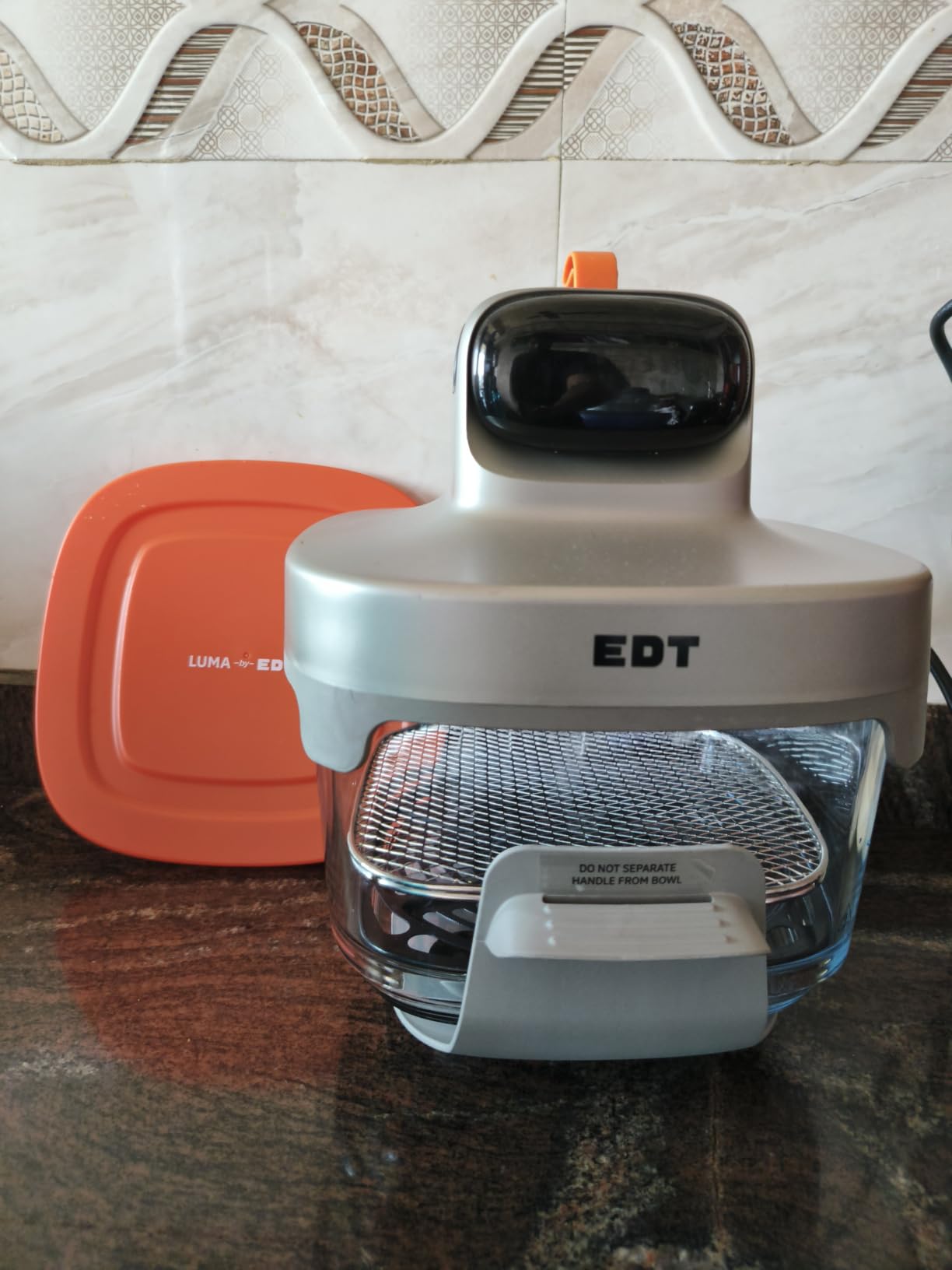
Most air fryers look the same: a black box, a plastic-feeling basket and a non-stick coating that quietly peels after a year or two. The EDT LUMA does the opposite. You cook inside a clear glass bowl, you can watch the food crisp up, and the brand says there is no PFAS, PTFE or ceramic coating anywhere near your food.
That sounds wonderful, and for the right kitchen it is. But glass also comes with questions. Is it fragile? Does it cook as well as a normal basket? What does a replacement bowl cost? In this review I go through all of it in plain words, with examples from normal Indian home cooking, so you can decide if the LUMA is worth your money.
- First impressions and design
- Specifications
- What is PureGlass?
- What is NutriRetain? (the claim, checked)
- Cooking modes and controls
- What can you cook? (picker)
- Which bowl for which family?
- Noise, cleaning and daily use
- The glass question: breakage and cost
- Marketing claims vs reality
- Pros and cons
- Who should buy it
- FAQ and final verdict
First Impressions and Design
The first thing you notice is the glass. Instead of a hidden basket, you get a see-through bowl that sits on a base unit called the NutriHob. It looks more like a modern kitchen gadget than a fryer, and it is genuinely nice on a counter. The base is compact, about 24 cm wide and 29 cm tall by the brand’s numbers, and it weighs about 6.2 kg including everything. That is a bit heavy, so once you place it, you will probably leave it there.
The second thing you notice is the habit it builds. In a normal air fryer, you pull out the basket every few minutes to check, shake and guess. Here you just look. For a beginner who always worries about burning things, that alone is a real comfort. You see the paneer tikka darken, you see the fries curl at the edges, and you stop the cooking exactly when you want.
Specifications at a Glance
| Feature | Details |
|---|---|
| Brand / series | EDT, LUMA series (made by EDTLIFE Technology Pvt Ltd, an Indian brand) |
| Model | AF70D (Grey Matter dual-bowl) |
| Power | 1500 W, 220 to 240 V, 50 Hz |
| Bowls | 4.5 L and 2.5 L PureGlass bowls (you use one at a time, as the listings describe) |
| Bowl material | 6 mm double-tempered borosilicate glass, no coating |
| Crisper trays | Two, uncoated stainless steel (SS304) |
| Temperature | 60 to 200°C in Chef Mode |
| Timer | Up to 60 minutes |
| Presets | Air Fry, Bake, Roast, Grill, Reheat, plus Chef Mode (custom) |
| Controls | Digital soft-touch panel with LED display, auto pause and resume |
| Noise (brand claim) | About 56 dB |
| Weight | About 6.19 kg |
| Warranty | 1 year (carry-in or doorstep depending on the pincode), covers manufacturing defects, not physical damage |
| In the box | NutriHob base, 4.5 L bowl, 2.5 L bowl, 2 crisper trays, food-safe bowl lid, manual |
What Is PureGlass, and Why Does It Matter?
A normal air fryer basket has a thin non-stick layer, usually a Teflon-type coating (PTFE). It works well when new. But if it gets scratched with a metal spoon, or overheated, the coating can chip. Nobody wants tiny coating flakes in their food. Over the last few years, many families in India have started asking for “coating-free” cooking for this reason.
PureGlass is EDT’s answer. The bowl is made of borosilicate glass, the same family of glass used in laboratory beakers and good oven dishes. It is chosen because it handles sudden temperature changes better than normal glass. There is no coating to scratch, so there is nothing to peel. Glass also does not hold smells or stains the way plastic does.
Think of an old steel tiffin and a plastic tiffin. After a year of masala curries, the plastic one smells and stays orange. The steel one comes clean. Glass behaves like the steel one. That is the everyday benefit.
The 450°C, 230°C, 220°C confusion
If you read the brand’s pages, you will see different temperature numbers for the glass: 450 to 500°C in one place, 230°C in another, and a 220°C test in the FAQ. These are not the cooking temperatures. They are material and test limits. What matters for you is the cooking range: 60 to 200°C. The brand also says the bowls survived 220°C for two hours followed by a cold dip. Treat that as a lab test, and still follow the golden rule with any glass: never put a hot bowl under cold running water.
What Is NutriRetain? The Claim, Checked
NutriRetain is the brand’s name for its temperature control. The idea is that sensors inside the unit keep reading the heat and adjust it, so the food does not get blasted at a much higher temperature than needed. Retailer pages mention dual sensors. The brand says this helps vegetables keep more of their vitamins, and quotes a figure of 41.4% more vitamins retained.
Here is my honest take. The temperature control part is sensible, because stable heat does cook better and avoids burnt edges. But the 41.4% number comes from the brand, and I could not find the test method behind it. So I treat it as a marketing line, not a proven fact. Plain air frying with a little oil is already a gentler way to cook vegetables than deep frying, and that is a real benefit by itself.
Cooking Modes and Controls
The control panel is a soft-touch panel with a bright LED display. There are five one-touch presets and a Chef Mode where you set your own temperature and time.
- Air Fry: for fries, pakoras, samosas, nuggets and anything you want crisp.
- Bake: for small cakes, muffins, cookies and brownies.
- Roast: for chicken pieces, vegetables, paneer and whole spiced items.
- Grill: for tikkas, kebabs and sandwiches.
- Reheat: a gentle preset (about 165°C for 7 minutes) for leftover pizza, rotis and fried snacks that would go soggy in a microwave.
- Chef Mode: choose any temperature between 60 and 200°C and up to 60 minutes. This is where you do your own cooking.
There is also a feature called NeuroKeep, which is simply a memory: if you pull the bowl out mid-cook to shake or turn the food, the machine pauses, and when you put the bowl back it resumes. A small thing, but it prevents the classic mistake of forgetting the timer.
What Can You Cook? Pick a Dish
This is the part that matters most. Choose what you cook most often, and I will tell you how the LUMA is likely to handle it, which bowl to use, and one tip. The settings are starting points based on the machine’s range and normal air fryer practice, so adjust to your food.
One pattern shows up in everything above. The LUMA is happiest with small to medium batches that you can see and control, and less happy when you pile in food and hope for the best. Glass heats evenly but more slowly than thin metal, so it rewards patience and a proper preheat.
Which Bowl for Which Family?
The “dual bowl” idea is easy to misunderstand. As the listings describe it, you get two interchangeable bowls, a bigger one and a smaller one, and you use one at a time on the same base. It is not two zones cooking different foods together. Use the quick guide below to decide how much you can cook at once.
Noise, Cleaning and Daily Use
Noise
The brand claims about 56 dB, and compares it with a louder rival. For reference, normal talking is around 60 dB, so on paper this is a quiet air fryer. Real noise depends on the fan speed and your kitchen, and I would treat the figure as a claim rather than a lab result. Even so, a quieter fan is a good sign for a machine you will run every day.
Approximate levels. The LUMA figure is the brand’s claim; the others are common reference values.
Cleaning
This is where glass wins. With no coating, there is nothing to protect from a scrubber. Warm soapy water takes off most residue, and the brand says the bowls and trays are dishwasher safe. Retailer notes suggest hand washing for a longer life, and I agree, because glass in a hot dishwasher cycle is exposed to more stress than it is in a sink. One user comment I came across said the NutriHob base cannot be washed with soap and water. Remember that rule: the base is electrical, so only wipe it with a damp cloth.
Preheating and speed
The brand says the LUMA preheats faster than its rivals, but gives no number. Plan on a short preheat before things like fries, and add a minute or two to recipes written for thin metal baskets. Glass is a great heat holder, so once it is hot, it stays hot and cooks evenly.
The Glass Question: Breakage and Cost of Ownership
I would be doing you no favour if I only praised the glass. Glass breaks. Borosilicate is far tougher against heat than ordinary glass, but a hard knock on a granite counter, a drop on the floor, or a sudden cold splash can still crack it. On one retailer page, several buyers mention breakage and weak handles, lids or trays. That is a small group of reviews, but it is a pattern worth knowing about.
The brand’s own site lists a replacement 2.5 L bowl at about Rs 3,999 and a 4.5 L bowl at about Rs 5,999. These prices can change, so check them. The warranty is 1 year and covers manufacturing defects, not accidental damage. So the honest question is: how careful are you in the kitchen? Try the calculator below to see what a replacement could add to your total cost.
My practical advice: keep the glass bowl away from the edge of the counter, never place it on a wet surface straight from the machine, let it cool for a few minutes before washing, and never use it on a gas flame or in a microwave. Do that and glass bowls last a long time.
Marketing Claims vs What They Mean for You
Product pages are full of big words. Here is a plain-language translation of the main ones. Tap each to open it.
“100% toxin free”
It means the food-contact parts are glass and uncoated steel, so there are no PTFE, PFAS or ceramic coatings. That is a real and useful difference. It does not mean the whole machine is free of plastic: the base, the lid and the handles still use plastic and silicone.
“41.4% more vitamins retained”
This is the brand’s figure and no test method is shown. Treat it as a marketing claim. The real benefit is stable, controlled heat.
“56 dB quiet operation”
A brand claim, probably measured under ideal conditions. Expect it to be on the quieter side of air fryers, but not silent.
“7-in-1 multi-function”
The brand lists six modes (air fry, bake, roast, grill, toast and reheat). One retailer counts steam as a seventh. In daily life, the five presets plus Chef Mode are what you will actually use.
“Dual bowl”
You get two bowls of different sizes, and you use one at a time. It is flexibility, not two cooking zones.
“AI kitchen” and Recipe Ramsay
This is a WhatsApp recipe assistant from the brand. It is a bonus, and the air fryer itself has no Wi-Fi or app.
My Rating
A good-looking, coating-free air fryer that is easy to clean and easy to watch. It loses points for the fragility of glass, a 1-year warranty, and some claims that cannot be checked.
Pros and Cons
- Coating-free glass bowl: no PTFE, PFAS or ceramic on the food side
- You can see the food cooking, so less guessing and burning
- Easy to clean, with no coating to protect from scrubbing
- Two bowl sizes for different amounts of food
- Wide 60 to 200°C range with a Chef Mode
- Auto pause and resume when you remove the bowl
- Looks great on a counter
- Brand offers doorstep service in many pincodes
- Glass can crack from a drop or a sudden temperature change
- Replacement bowls are costly
- Only 1 year of warranty, and accidents are not covered
- Bowls are used one at a time, not together
- Heavy at about 6.2 kg for an air fryer
- Some claims (vitamins, noise) are not independently tested
- No app or Wi-Fi on the machine itself
- Not the cheapest air fryer on the market
Who Should Buy the EDT LUMA?
Buy it if you:
- Care about avoiding non-stick coatings in your cooking
- Cook for 1 to 4 people and like to watch the food as it cooks
- Want an air fryer that is also nice to look at
- Are a careful user who treats glass kitchenware gently
Think twice if you:
- Have small children or a busy, crowded kitchen where things get dropped
- Cook large family batches, since a single bowl is limited
- Want the lowest possible price, because a basic coated air fryer costs much less
- Need a longer warranty
Tips to Get the Best Results
- Always preheat. Glass needs a minute or two to build up heat, and food goes in better onto a hot bowl.
- Do not overcrowd. Hot air has to move around the food. Cook in two rounds rather than one packed round.
- Use a little oil. A teaspoon of oil sprayed or tossed through makes a big difference to crispness.
- Let the bowl cool before washing. This is the number one rule for glass.
- Place it on a flat, heat-safe surface and keep the vent at the back clear of walls.
- Do not use metal tools that scrape hard. Even though glass is scratch-resistant, silicone or wooden tools are kinder to it.
Frequently Asked Questions
Is the EDT LUMA really coating-free?
The bowl is uncoated borosilicate glass and the crisper trays are uncoated stainless steel, according to the brand. The base and lid still contain plastic and silicone parts.
Can I cook two things at the same time in both bowls?
No. The listings describe two interchangeable bowls that you use one at a time on the same base.
What is the temperature range?
In Chef Mode you can set 60 to 200°C for up to 60 minutes.
Is it dishwasher safe?
The brand says the bowls and trays are dishwasher safe. Hand washing is the gentler choice for glass. Never put the base unit in water.
What if the glass bowl breaks?
Accidental damage is not covered by the 1-year warranty. The brand sells replacement bowls separately, and offers a 7-day replacement for items that arrive damaged or defective, so record an unboxing video when your parcel arrives.
Is it noisy?
The brand claims around 56 dB, which is on the quiet side. Real-life noise depends on fan speed.
Does it work on normal Indian voltage?
Yes. It is rated for 220 to 240 V and 50 Hz. At 1500 W, use a proper wall socket and not a thin extension board.
Can I bake a cake in it?
Yes, there is a Bake preset, and the glass holds heat well. Use a small cake tin that fits inside the bowl and check early.
Final Verdict: Is the EDT LUMA Worth It?
The EDT LUMA is one of the most interesting air fryers you can buy in India right now. The glass bowl means you can see your food, clean up easily and skip non-stick coatings. For people who have been worried about those coatings, that is a strong reason to choose it.
It is not perfect. Glass needs care, replacement bowls cost real money, the warranty is one year, and a few of the headline claims cannot be checked independently. A cheaper coated air fryer will cook just as well for most simple jobs.
My advice: if you want a coating-free, good-looking air fryer for a small or medium family and you handle your kitchen things with care, the LUMA is a very good buy at around 7.6 out of 10. If you want the lowest cost and the toughest build, a basic steel-and-coated model may suit you better.
Disclosure: This page contains affiliate links. If you buy through them I may earn a small commission at no extra cost to you. This does not change my opinion. Specifications come from the brand’s website, retailer listings and independent reviews, and may change. Please check the latest details, price and warranty on Amazon before you order.